My AWS Journey
Introduction
There’s a phrase I really like: Jack of all trades, master of none. That’s why I always say I’m going all the way with the world of Software Engineering in general. What happens is that if you’re a person eager to be continuously learning (something that definitely fits me), you might get bored from time to time and then look for a new area to expand into. One of these areas I found was Cloud Computing, specifically (though not limited to) AWS, and in this article, I’ll show you my strategy for learning about it and for obtaining the two certifications I currently hold.
Experience
I have about two years of experience with AWS, and I still remember the first time I logged in, I said to myself, what’s the use of this thing that looks so complicated? 😂. Of course, I never would have imagined that two years later it would precisely be one of the skills that would give me the most value in the professional market. But well, I remember that with that first experience I did some not-so-simple things but without truly understanding what was happening behind the scenes in AWS. I had to migrate from Google Maps to AWS Location Services, and it wasn’t that simple, because we’re not just talking about maps, but also Geolocation, route calculators, and other small details.
After that, I took charge from a technological standpoint of Toditico (an experience I’ll talk about in future articles), and this was the first project I did completely from scratch. Although it wasn’t very complex, at that time it helped me understand a lot about serverless applications mainly (which, as I’ve already said, is my preferred way to deploy applications, although nothing is perfect) and I was able to ‘play’ a lot with all of this and solidify my knowledge.
Between the two aforementioned projects, I gained about a year and a half of experience with AWS, and then came Basset, an experience that I’m sure I’ll always remember for many reasons, because I’ve met very capable and humane people, and because from a technological point of view, it’s quite a challenge. The idea is not to delve too much into the Basset topic (I’ll probably write an article about that later), but to make it clear that this is the project that has demanded the most from me so far, and not just from an AWS perspective. It’s also the experience that has led me to want to understand AWS in detail, and consequently, to get certified on this platform.
Are AWS certifications worth it?
This is quite a controversial topic, as there are different opinions, but the first thing I’ll tell you is that if you think that just having the certifications makes you a qualified professional in the field, from my point of view, you’re mistaken. AWS is an immense platform where if you don’t practice daily, and also, don’t properly understand the underlying concepts, you probably won’t be the best candidate for the position you’re looking for (and believe me, the interviews aren’t easy).
Now, I’m not saying they’re useless either; if that were the case, I wouldn’t have gotten them. As I see it, you need a bit of both: daily practice will help you stay up-to-date with concepts from an operational standpoint. But certifications will help you study and understand concepts that you probably never would have studied or understood without them. Furthermore, without a doubt, they are a shining star on your CV, especially the professional-level ones. This will help you pass the recruiters’ filter, but as I said before, the technical interview is where you truly have to demonstrate your knowledge and worth. In summary:
- Having certifications is not enough to be a professional proficient in the specific subject.
- Certifications will help you study and understand concepts that you probably wouldn’t understand without them.
- They are highly regarded in the tech sector, so having them on your CV is a big plus.
My Strategy
Ever since I found out in December 2024 that I would definitely be moving to the United Arab Emirates, I set a clear goal for myself: I have to start studying AWS to get a couple of certifications (I’m Cuban, and with a Cuban ID, you can’t take AWS exams). I remember talking to a good friend of mine (almost a brother) and asking him to buy Stephane Maarek’s Udemy courses for the following certifications:
These courses are quite famous, and Stephane is a well-recognized instructor in the AWS field, and consequently, his courses are expensive, approximately 100USD. As you can imagine, we weren’t willing to spend that much money at that moment. For that reason, and as good planners, we decided to buy all three courses on Black Friday (he who fails to plan, plans to fail 😂). Thanks to this, we spent, if I remember correctly, less than 40 dollars on all three courses, not bad at all.
From then on, I started studying. I remember learning many things related to how to design your architectures in AWS and security, from security groups to ACLs. When I thought I was ready (it took me about a month and a half of regular study), I asked several people I know how to practice for the exam, and that’s when they told me about Tutorials Dojo, for me, the learning platform with the best practical courses for AWS.
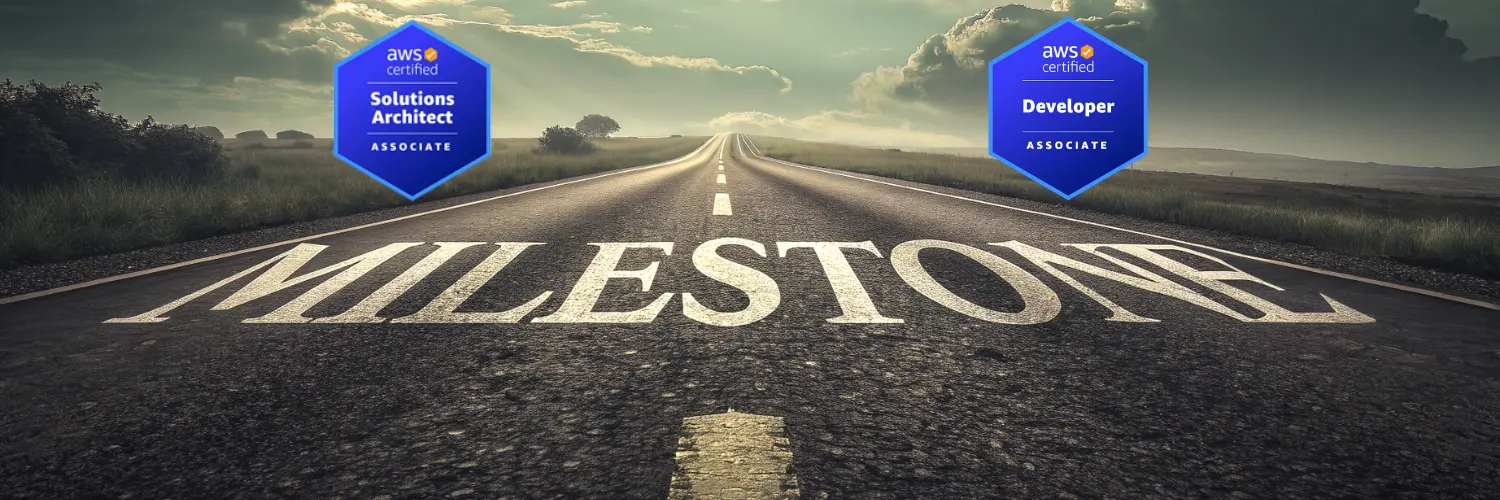
I dedicated about a month to preparing for the certification exam, and on February 28, 2025, I obtained my first AWS certification, the Solutions Architect Associate. I won’t deny that I felt super good about it, and I wanted to seize that moment and immediately started studying for the next certification: Developer Associate. In this certification, I learned a lot about DynamoDB, deployment types mainly in ECS, Parameter Store, and Lambda functions in general. I used the exact same strategy: Udemy for the content and Tutorials Dojo for the practice exams. And so, two months later, I obtained my second AWS certification, Developer Associate.
In summary, the strategy I recommend, mostly because it’s the one that has worked for me, is as follows:
- Use Udemy to learn the content itself, specifically Stephane Maarek’s courses.
- Use Tutorials Dojo to practice for the exam.
Next Steps
The 3rd certification I want to get is the SysOps Associate, which, according to what I’ve read from various sources, shares a lot of common content with the two associate-level ones I already have. The difference is that for this one, I didn’t use Stephane Maarek’s courses; instead, I’m doing everything through Tutorials Dojo. I’ll tell you how it goes when I take the exam.
You’re probably wondering why I’m not doing the DevOps Professional exam since I already bought the course. The thing is, this certification is professional-level, and I think it’s better to face it when I have more experience in AWS. I’ll most likely do it next year. Also, I’ll probably do the AI Practitioner this year, which is foundational level, mostly to understand Artificial Intelligence a bit on an engineering level, but it’s not a topic that interests me much per se; I prefer to focus on the cloud.
See you soon
That’s all for now regarding my AWS journey and certifications. I’ll keep posting updates here whenever I feel there’s something important to share. Have a great day and remember that your comments help me a lot, not for metrics, but emotionally.