How GitLab Can Boost Your Professional Career
Introduction
In this article, I’ll talk about GitLab, a platform you probably know as the direct competitor to GitHub, but that’s precisely what I want to change with this article. I will show you the advantages of using GitLab and how it can help you in your professional growth.
Why GitLab?
Normally, most developers use GitHub. I personally refer to it as the Instagram for developers, where a repository with 10 ⭐ is equivalent to a post with ~100 👍 (a very personal opinion of mine 😂). The real advantage of GitHub is the visibility for open-source projects; that is, if you want to develop a new React component, you host it on GitHub and you get good visibility for the repo (the ⭐ count depends on how useful your project is). Perfect, you probably already know about the benefits of GitHub, but why should you get familiar with GitLab?
Open Source
For me, the main advantage that GitLab offers, from a professional development point of view, is that it is open source. Yes, this means that you can understand how one of the most used platforms in the software development world is designed, but that’s not all. YOU CAN ALSO CONTRIBUTE. Yes, you read that right. Whether you are a Frontend, Backend, DevOps, or any other IT-related specialist, you can simply create an MR (the same concept as PRs in GitHub, but here they are called Merge Requests instead of Pull Requests) and contribute to this platform. Keep in mind that the most used languages in GitLab are Ruby on Rails, Golang, Python to a lesser extent for artificial intelligence, and Vue.js on the frontend. For me, this alone is more than enough to get my attention, but below I’ll share other reasons with you.
Contributor Onboarding
For GitLab, it’s important that anyone can contribute, and for that reason, they have taken the contributor onboarding process very seriously. Once you request access as a contributor, they send you an email with all the necessary information and assign you an issue where one of the mentors will guide you through the entire process. Once you are approved as a contributor, another advantage is that you get a GitLab Duo license (GitLab’s equivalent of GitHub Copilot). As if that weren’t enough, community meetings are held weekly, where you can meet other contributors, analyze tickets, and help other contributors with their questions.
Contributor Rewards
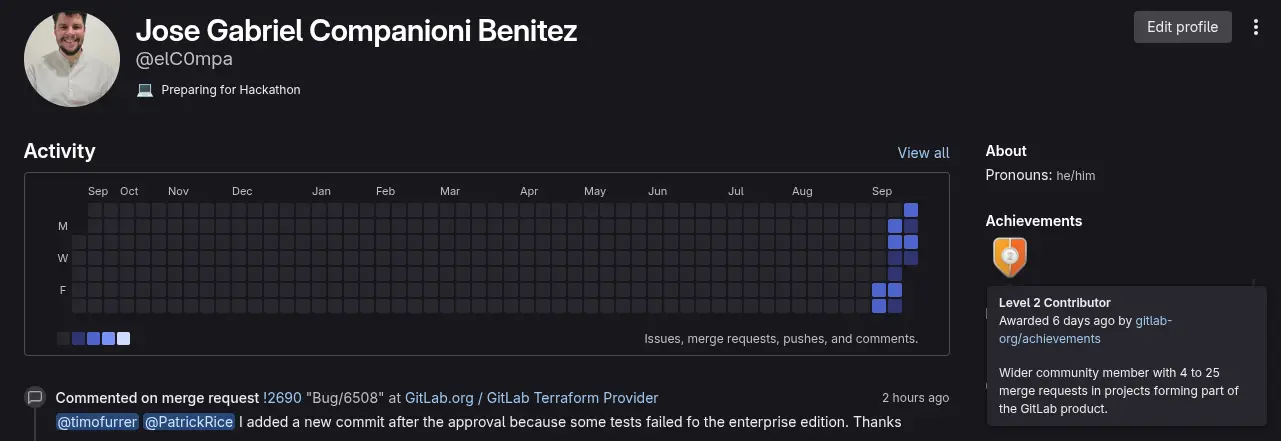
As part of the community, GitLab designed a rewards system for contributors. Basically, there are different contributor levels, with each of these levels having different requirements, making it more interesting 😂. It’s important to note that the only way to earn these points is not by programming; you can also earn points through translations, creating issues, and even if you are a content creator, whether on a YouTube channel or a blog, any of these activities will give you contribution points. You can redeem these contribution points at the GitLab rewards store, where you can get sweaters, stickers, decorations, and many other GitLab-related items. In addition to this, as a form of recognition, GitLab gives you a badge that is visible on your profile, which I show you in the following image:
Hackathon
This is one of my favorites (I’m quite competitive 🏆). It’s basically a competition that takes place every three months (January, April, July, and October). This competition lasts for one week, and you accumulate points for every MR you make. If this MR is linked to a ticket, you earn more points. MRs merged up to one month after the competition still accumulate points. At the end of the competition, the top three places get a special badge on their GitLab profile and earn points to redeem at the GitLab rewards store.
Labelathon
This is similar to the Hackathon, but in this case, the competition consists of labeling issues, promoting good practices related to backlogs. It’s an initiative to encourage non-code contributions so that more people become interested in being part of the community.
Until next time
This is the beginning of a few articles in which I will share my experiences as a GitLab contributor and how it could also be beneficial for you. If you are interested in the content I publish, don’t forget to subscribe to my newsletter in the form at the end of the article.